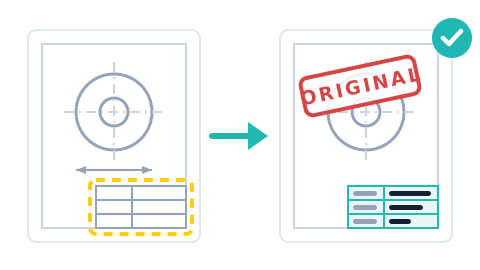
Before production, every technical drawing needs its release stamp: date, editor, quantity, assembly. The trouble is, the title block sits somewhere different on every drawing — sometimes landscape, sometimes portrait. By hand, that means: open, search, position, type. Per drawing. With series of hundreds of drawings, a real time sink.
A Docker container does in minutes what used to be an afternoon at the screen.
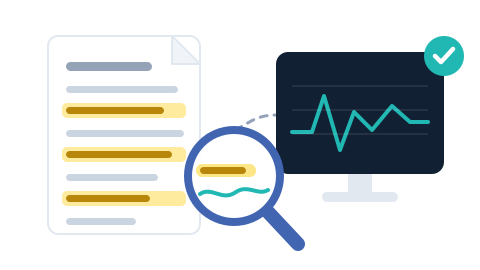
A template-matching approach (OpenCV) searches for the title block on every page — no matter how the drawing is oriented. All four orientations (0, 90, 180, 270 degrees) are checked and the size is searched across 25 scaling steps until the match is certain.
The detected position is automatically converted from pixels to PDF coordinates; the values come from a companion file per drawing. Font, size and color are configurable for each field — with a red “ORIGINAL” imprint on request.
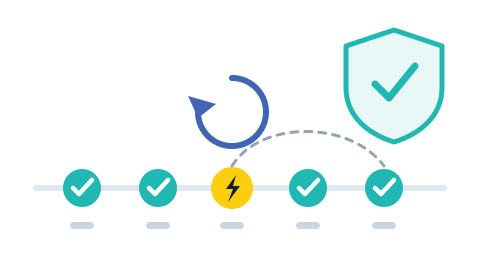
As a Docker container, the stamper processes entire batches: hundreds of drawings in minutes. Pages without a title block pass through unchanged, and a corrupt PDF doesn't stop the batch — it is logged, and the rest keeps running.
No magic — just craftsmanship.
Fixed coordinates work exactly until the first drawing that is laid out differently. That's why the title block is searched for anew on every page — the solution adapts to the drawings, not the other way around.
A page without a title block? Passes through unchanged. A corrupt PDF? Logged and skipped. With hundreds of drawings per batch, that is exactly the difference between “running” and “stuck”.
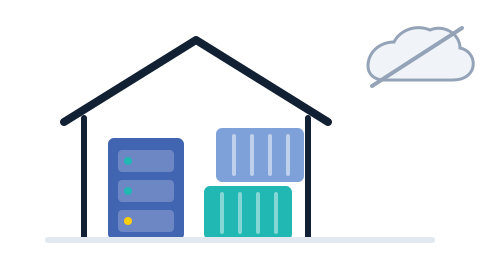
Runs on your existing infrastructure, no cloud requirement. Your drawings — and with them your design know-how — never leave the building.
The release stamp is just one example. The same technique fills in, marks or checks anything that moves through your business as a PDF — even if it sits somewhere different on every page.
If someone in your company stamps, labels or sorts PDFs by hand: tell us about it. Manual steps like these can almost always be automated.
Get in touch